

21/04/2026
According to Selçuk Artut, technological art has the potential to transform the world into a visual feast by taking our familiar reality to different dimensions.
Have you ever met a member of a rock band who says they admire the mathematical structure of Bach's music and create music inspired by his chord patterns? Only someone who has deeply internalized mathematics and music could make such an assessment. I have met such a person, and I am fortunate to have had the chance to know him.
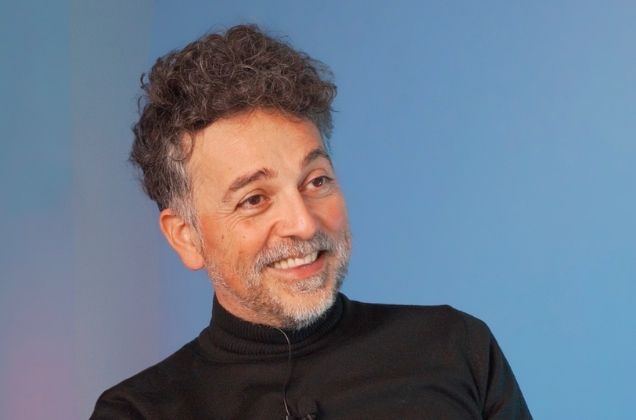
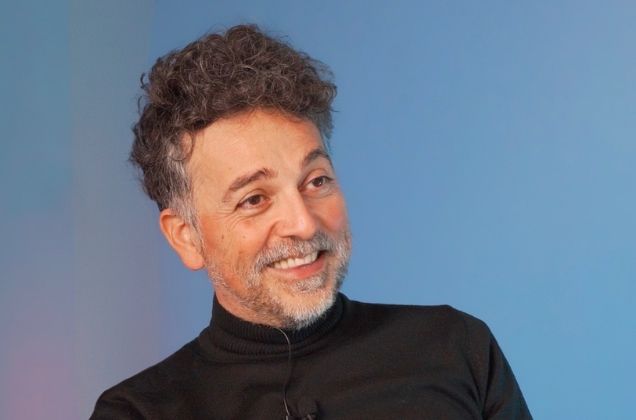
This Bach-loving musician is Prof. Dr. Selçuk Artut, a faculty member at Sabancı University's Visual Arts and Visual Communication Design Program. I believe the word that best describes Artut is "hazerfen." In other words, this word of Persian origin, meaning "one who knows/does many things," is used for versatile, skillful, and talented individuals who possess extensive knowledge in multiple scientific fields. Artut fully deserves this description, because how else can one define a person who wears various "hats"—an academic, mathematician, musician, philosopher, multifaceted artist, creative coder, and so on?
Technology-Human Interaction
Artut points out that in all his work, his main goal is actually to redefine the relationships between art, technology, and society. In his book, Technology-Human Coexistence, which he wrote on human-technology relations, he emphasizes the potential of technology to take existing reality to different dimensions. He explains his reason for writing the book as follows: “This work is an attempt to analyze the situation regarding the understanding of the common interactions of technology and human nature, which have a complex character in their different dimensions. By defining order and disorder with rational methods, technology, which keeps the world under control as much as possible, will continue to offer people unprecedented new lifestyles...”
Stating that our age is under the intense influence of technology, Artut expresses how technology creates confusion while presenting reality to us as follows: “Our lives filled with four-sided screens persistently focus on the issue of information and, while presenting information, lead individuals to astonishment and confusion by differentiating their perceptions of reality.”
Reality becoming a subject of design
Technology is indeed confusing because it has the potential to “bend” reality. Artut, who prefers the term technological art instead of digital art, says that today, thanks to technological art, people can be pulled out of the World of Chaos they are in and given the chance to meet an infinite World of Serenity. So how does he achieve this?
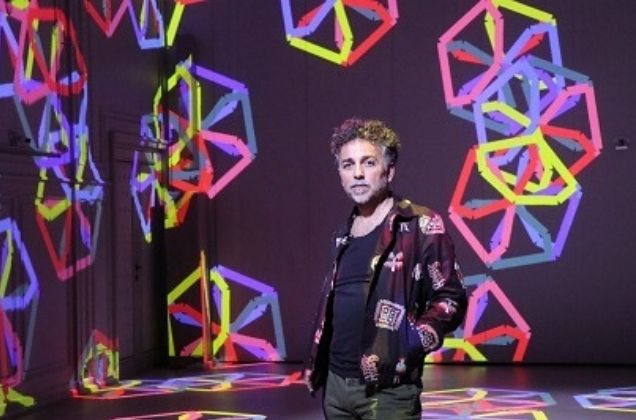
The interactive artwork titled "Motifs Extending to Infinity: Reinterpretations," which Artut presented last year at the HOPE Alkazar art center, a former famous cinema in Istanbul, is a prime example of this. In this work, Artut draws on the connections between the geometric art of the past and the media art of today. By combining sound and image in the space, he invites visitors to interact with their environment. Visitors can change geometric patterns by selecting from the content prepared by Artut with the help of an interface, and experience a "state of visual and auditory immersion" accompanied by generative music inspired by Bach. Artut says his aim is to create a "Tabula rasa," meaning to put people into a meditative state and free them from their anxieties. In other words, to isolate them from the outside world.
Creative Coding and Geometric Patterns
Artut explains how his interest in geometric art developed: “In art projects, I don't want to put myself in any categorization. I think we need to digest those deeply rooted things of tradition and find ways to honestly and sincerely transmit them to the future. That's how culture is built. Lately, as a result of my mathematical background and passions, I started to become interested in geometric art. Geometry is something that exists in our lives. Islam, in particular, has embraced this art very much. I started doing some work and conducted mathematical and geometric analyses by examining these motifs. Then I started producing them with computer codes. These works mean reviving the values of the past. In this way, I ensured that the culture that was shrouded in mist reached the present day.”
Artut's book, in which he explains how he created animations related to twenty-three different geometric patterns that he worked on for 2-3 years, was first published by a publishing house in New York. Then, in 2023, it was published by Nesin Publishing under the title Creative Coding and Geometric Patterns: Coding for Art.
This work, offering an interdisciplinary perspective on art history, deeply analyzes the relationships between geometric art and media art.
In the introduction, Artut presents his book as follows: “This book analyzes twenty-three different geometric patterns that have traditionally appeared throughout history, offering a series of workflows for producing them using creative coding methods....I hope that by progressing through the book, you will effectively understand computer-generated geometric patterns along with code examples to create your own unique designs....My aim is to preserve the traditional anonymity on geometric art by using open-source collaboration. Sharing is caring!”
Activities he pursued with his music hat
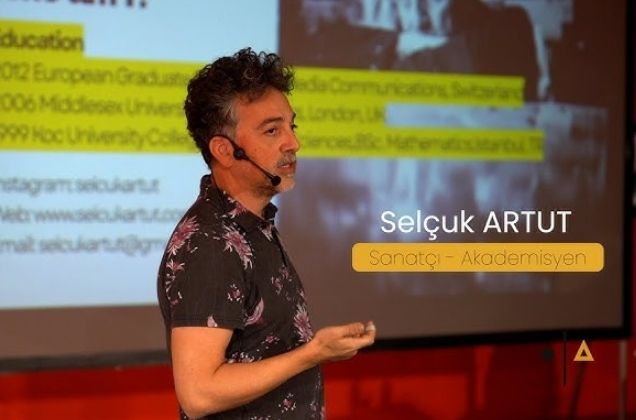
Since 1998, he has released many albums and given numerous concerts both domestically and internationally with the rock avant-garde music group Replikas, of which he is a founding member. The group is currently inactive.
Selçuk Artut also has an experimental music group called RAW. Founded with Alp Tuğan, who teaches creative coding and sound at Özyeğin University, the group presents auditory and visual performances using live coding methods. Their performances are based on improvisation. The duo, in an unconventional way, invites the audience to be active observers of the production process. Their performances are produced on stage with overhead cameras and code visuals projected on large screens.
How to be a multifaceted scientist and artist?
He received his undergraduate degree from Koç University, Department of Mathematics, his master's degree from Middlesex University, London, Department of Sound Arts. He completed his doctorate at the European Graduate School, on the Philosophy of Media Communication.
Artut, a faculty member at Sabancı University's Visual Arts and Visual Communication Design Program in Istanbul, focuses on bridging the gap between art and technology through his courses on creative coding, artificial intelligence and art, computational art, and media art – art applications. Throughout his career, he has traveled to over thirty countries across six continents, giving conferences, presentations, and workshops, fostering intercultural dialogue on art, technology, and creative innovation. He is currently working on multiple projects. Artut's artwork can be seen in his solo exhibition at the Terakki Foundation Exhibition Hall from March 25 to April 24, 2026; in a group exhibition at Çubuklu Silos from March 20 to June 21, 2026; and in a solo exhibition at canvas Dubai in the United Arab Emirates from February 5 to April 10, 2026, focusing on inclusive experiences.
Sources:
https://www.youtube.com/watch?v=jLglShjGabI&list=PLAu_bhRh-4eLKOsA1wwBMldWhgXZWI-NL
https://www.youtube.com/watch?v=bz8Baoqy54s
Teknoloji-İnsan Birlikteliği-Ayrıntı Yayınevi
Yaratıcı Kodlama ile Geometrik Desenler: Sanat için Kodlama – Nesin Yayıncılık


